Tattoo Removal in Nagano: Sessions, Cost & Pain — English-Friendly Guide
Living in Japan with a tattoo can be complicated. A 2015 Japan Tourism Agency survey found that 55.9% of hot spring facilities turned away guests with tattoos, and many gyms and pools still ask visitors to cover up. Whether you want to enjoy onsen freely, prepare for a job search in Japan, or simply move on from an old design, laser tattoo removal is a realistic option — and you don’t need to travel to Tokyo for it.
This guide explains how picosecond laser removal works, how many sessions you’ll need, what it costs at Ueno Clinic in Nagano City, and how to book in English.
Key takeaways
- Laser is the standard first-line method for tattoo removal — it targets ink without cutting the skin
- Picosecond lasers remove tattoos in fewer sessions than older Q-switched lasers, with less pain and fewer pigment problems, according to systematic reviews
- A professional all-black tattoo typically needs 4–8 picosecond sessions, spaced 2+ months apart
- Full-color tattoos need multiple wavelengths — Ueno Clinic has three (532 / 755 / 1064 nm) in one clinic
- Pricing is size-based and transparent: from ¥11,000 per session for 1 cm² (cosmetic treatment, not covered by insurance)
- English support is available by email and LINE (phone support is Japanese only)
Why do people remove tattoos in Japan?
Mostly for practical reasons: onsen and sento access, gym and pool rules, job hunting, and family life.
Tattoos in Japan carry a historical stigma, and although attitudes are softening — the government advised bathing facilities in 2016 that refusing entry solely for tattoos is inappropriate, and recent surveys show about 60% of people support relaxing the rules — many facilities still restrict entry or require cover stickers. Common situations we hear about at the clinic:
- You want to enjoy onsen trips with family or colleagues without worrying
- Your gym or pool requires tattoos to be covered
- You are job hunting in Japan, where visible tattoos can still be a disadvantage
- The tattoo simply no longer fits your life
Removal takes months, so if you have a deadline (a wedding, a job search season), it pays to start early.
How does picosecond laser removal work?
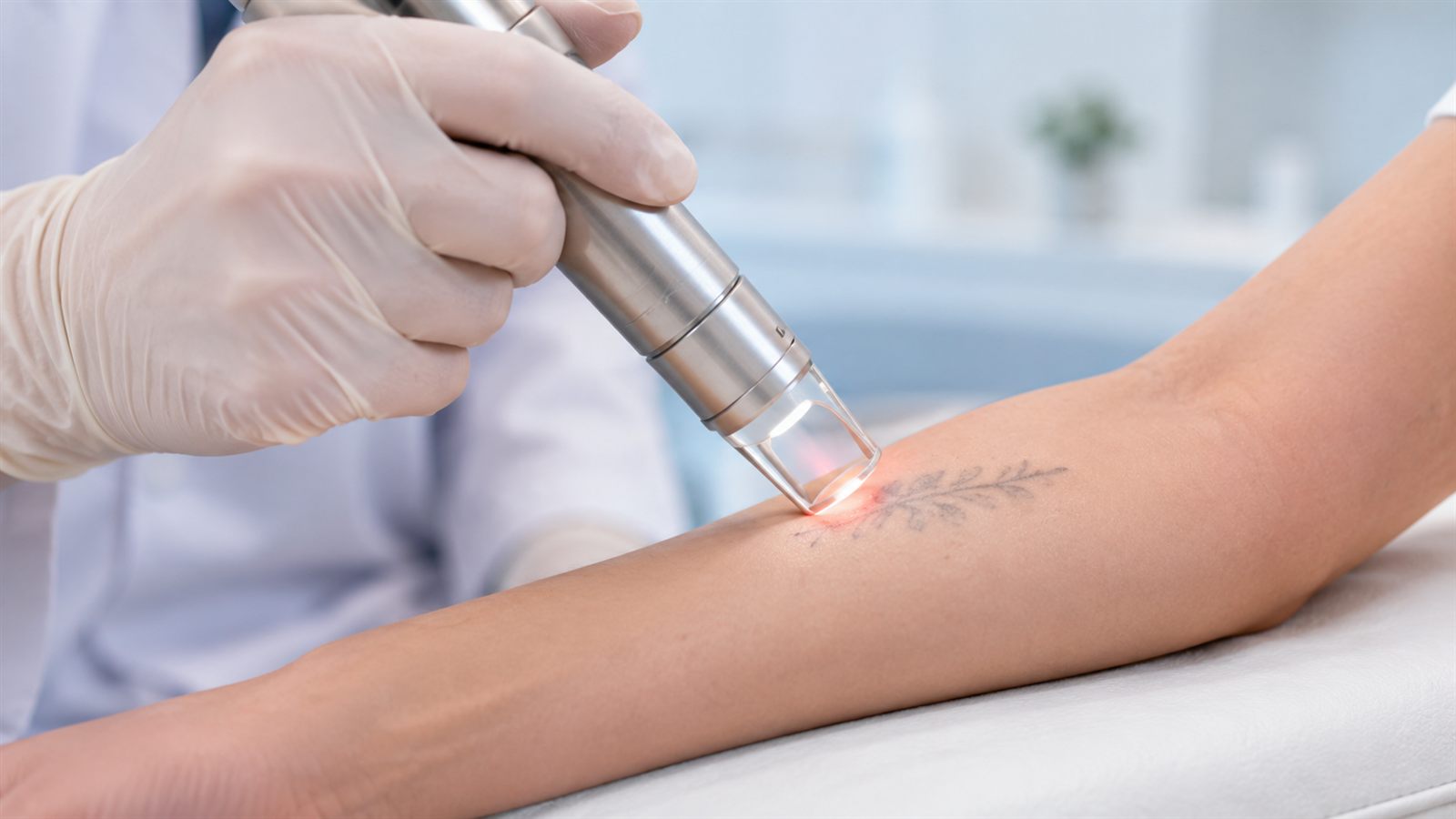
The laser delivers ultra-short pulses that shatter ink particles into fragments small enough for your immune system to clear away — without cutting the skin.
Older Q-switched (nanosecond) lasers break ink mainly with heat. Picosecond lasers use pulses roughly 1,000 times shorter, creating a photoacoustic (shockwave-like) effect that fragments ink more finely. Clinical evidence consistently favors the newer technology:
| Q-switched (older) | Picosecond | |
|---|---|---|
| Typical sessions | 8–12 | 4–8 |
| Black ink clearance | 50–75% in 8–10 sessions | 60–90% in 4–6 sessions |
| Pigmentation risk | Higher | Lower |
| Pain | Like a snapping rubber band | Milder, shorter |
A systematic review of 36 studies concluded picosecond lasers achieve over 75% clearance even for difficult blue, green and yellow inks, with less pain (Gurnani 2022, JAAD). Another major review found fewer sessions and fewer pigment changes compared with Q-switched lasers (Wu 2021, Lasers in Surgery and Medicine).
Ueno Clinic uses PicoSure (FDA-cleared picosecond laser, 532/755 nm) plus a Q-switched Nd:YAG (1064 nm) — three wavelengths covering black through colored inks in a single clinic, which is rare in Nagano Prefecture.
How many sessions will I need?
For a professional all-black tattoo, plan on 4–8 picosecond sessions. Color, location and layering add sessions.
Dermatologists estimate session numbers with the Kirby-Desai scale (Kirby 2009), which scores six factors: skin type, body location, ink color, ink amount, scarring, and layering (cover-ups). In the original 100-patient study, the average was about 10 sessions (range 3–20) — modern picosecond lasers tend toward the lower end.
Rules of thumb:
- Black fades fastest (1064/755 nm); red responds well to 532 nm
- Blue, green and purple respond well to 755 nm picosecond treatment (one study: 85% purple / 81% blue / 74% green improvement after 4 sessions — Bernstein 2018)
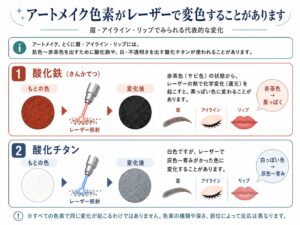
- Yellow, white and skin-tone inks are the hardest; white/skin-tone cosmetic pigments can paradoxically darken, so we always test-fire first
- Hands, feet and ankles clear more slowly than the torso
- Sessions are spaced 2 months or more apart so your body can clear the fragmented ink
Total time is typically 6 months to 2 years.
Does it hurt? What is the downtime?
Most people describe it as a rubber band snapping against the skin. Numbing cream is available, and each session is short.
Right after treatment the ink turns frosty white for a few minutes, then a scab forms and falls off in 5–7 days. Redness settles over about a month, and the ink visibly fades over 3–6 weeks. Possible side effects include temporary blistering and pigmentation changes, rare hypopigmentation or scarring, and allergic reactions (mainly to red ink). Original needle marks from the tattooing itself may remain.
Aftercare is simple: don’t pick the scab, keep the area moisturized, and protect it from the sun for several weeks. Avoid long baths, saunas and hard exercise while the skin is red or blistered.
Cost at Ueno Clinic (Nagano City)
Tattoo removal is a cosmetic (self-paid) treatment in Japan — health insurance does not apply. Ueno Clinic charges by size, per session (tax included):
| Size | Price per session |
|---|---|
| 1 cm² | ¥11,000 |
| Up to 5 cm² | ¥22,000 |
| Up to 10 cm² | ¥33,000 |
| Up to 50 cm² | ¥55,000 |
| Up to 150 cm² (postcard size) | ¥110,000 |
| Multicolor tattoos | +20% |
| Numbing (optional) | ¥3,300 (up to 50 cm²) / ¥6,600 (larger) |
Example: a black tattoo up to 5 cm², removed in 6 sessions, costs about ¥132,000 total (plus optional numbing). These rates are in line with major national clinic chains — without the trip to Tokyo. A same-day cancellation fee (¥5,500) applies, and all patients sign a standard declaration form before treatment.
How to book in English
- Email or LINE is best — our staff can respond in English by email; phone support is Japanese only
- Add us on LINE or use the contact form
- At your consultation, the doctor examines the tattoo’s colors, depth and location, then gives you an estimate of sessions and total cost before any treatment
- Reception hours: 9:30–17:00 / Beauty desk: 026-235-3514
More about our English-speaking services: International customers page
FAQ
How many sessions does tattoo removal take?
Typically 4–8 picosecond sessions for a professional black tattoo, more for colorful, layered, or hand/foot tattoos. You get a personal estimate at the first consultation.
How much does tattoo removal cost in Japan?
At Ueno Clinic, from ¥11,000 per session for 1 cm² up to ¥110,000 per session for postcard size, plus 20% for multicolor. It is not covered by health insurance.
Does laser tattoo removal hurt?
It feels like a rubber band snap. Picosecond lasers hurt less than older lasers, and numbing cream is available from ¥3,300.
Will there be a scar?
Scarring is rare with proper settings and intervals, but original needle marks and temporary pigment changes can remain. Results vary between individuals.
Can I go to the onsen during treatment?
Avoid soaking while the skin is scabbed, blistered or red — usually 1–2 weeks after each session. Your doctor will advise you at each visit.
Do you treat colored tattoos?
Yes. With three wavelengths (532/755/1064 nm) we treat black through most colors. Yellow and fluorescent inks are the most stubborn and may need extra sessions.
Summary
Tattoo removal in Japan is a marathon, not a sprint — but with picosecond technology it is a shorter marathon than it used to be. If you are in or near Nagano, you can get an evidence-based estimate of sessions and total cost at a local clinic, in English, before committing to anything.
Contact us on LINE or via the contact form — English email support available.
Related pages
- Tattoo & permanent-makeup removal (treatment details, Japanese)
- PicoSure laser details (Japanese)
- Services for international customers (English)
Medically reviewed by the doctors of Ueno Clinic (Orthopedics / Cosmetic Dermatology, Miwa, Nagano City).
This article provides general medical information and does not guarantee specific results. Outcomes and risks vary between individuals.
References
- Wu DC, et al. A Systematic Review of Picosecond Laser in Dermatology. Lasers Surg Med. 2021;53(1):9-49. DOI: 10.1002/lsm.23244
- Gurnani P, et al. Comparing the efficacy and safety of laser treatments in tattoo removal. J Am Acad Dermatol. 2022. Link
- Bernstein EF, et al. Lasers Surg Med. 2018. DOI: 10.1002/lsm.22942
- Kirby W, Desai A, et al. The Kirby-Desai Scale. J Clin Aesthet Dermatol. 2009;2(3):32-37. PMID: 20729941
- US FDA. Tattoo Removal: Options and Results. Link
- Japan Tourism Agency 2015 survey on tattoo policies at bathing facilities. Summary (Japanese)
Last updated: July 27, 2026